
Intro
Two tanks can sit on the same property and do opposite jobs. One holds the water your family drinks, cooks with, and bathes in. The other holds wastewater that must never come near it.
In the UAE, villas, labour accommodations, farms, and commercial sites often need both. The problems start when the two are treated as interchangeable — the same kind of tank, in the same kind of spot, with the same fittings — or when a septic tank is added later without thinking about where the drinking-water tank already sits. This guide explains what each tank is for, why separation matters, and the simple checks that keep drinking water safe.
What Each Tank Is For
A drinking-water tank stores clean water for everyday use. It is filled from the mains supply or a tanker, and its job is to keep that water clean until it is used. Everything about it — its material, its lid, its fittings, its placement — exists to protect the water inside from dust, insects, sunlight, and contamination.
A septic tank is part of a wastewater system. It receives used water from toilets, bathrooms, and kitchens, and holds it so solids can settle and the liquid can move on to the next stage of treatment or disposal. It is not a storage tank for clean water, and it is never meant to supply a tap.
The two tanks look similar from the outside. Both are often made from GRP fiberglass or PVC, both are sealed with lids, and both sit on or under the ground. That similarity is exactly why the distinction matters: a tank is defined by what it holds and how it is connected, not by its shape.
A used tank that once held wastewater should never be cleaned out and reused for drinking water. Once a tank has held sewage, it stays a wastewater tank. If you are buying second-hand, this is the first question to ask — what did this tank hold? — and an unclear answer is reason enough to walk away.
Why Separation Matters
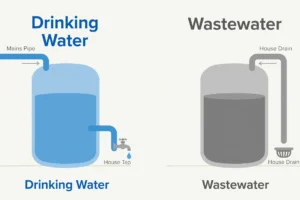
Drinking water stays safe when nothing from the wastewater side can reach it. Separation works on three levels at once:
Physical separation. The two tanks should be in different places, not side by side with shared pipework. Each tank has its own inlet, its own outlet, and its own overflow. No pipe should connect the septic side to the drinking-water side, and no fitting should be shared between them.
Protection from leaks and overflow. Every tank can leak, and every tank can overflow. If a septic tank leaks or overflows near a drinking-water tank, wastewater can reach the ground around it, and from there the drinking-water tank’s fittings, base, and surroundings. Distance and ground level both matter: a septic tank should never sit uphill from a drinking-water tank, where a leak would run toward the clean supply.
Protection from mistakes. On a busy site, a tank that is not clearly marked is a tank that can be filled or connected wrongly. A drinking-water tank and a septic tank that look alike, sit close together, and carry no labels are an accident waiting for a busy day. Clear labelling — which tank is which, on the tank itself and on any nearby pipework — is not paperwork. It is the simplest safety measure on the property.
None of this needs complex equipment. It needs two separate systems, kept apart from the start, and checked from time to time.
What to Check Before a New Tank Goes In
If you are adding a septic tank to a property that already has a drinking-water tank — or the other way round — run through these questions before the new tank is placed:
- Where does the new tank sit relative to the old one? Keep them well apart, with the septic tank never uphill from the drinking-water tank. If the plot is small, ask the installer to confirm the layout before work starts rather than after the tanks are in the ground.
- Are the pipe runs fully separate? Drinking-water pipes and wastewater pipes should follow different routes, with no shared sections and no cross-connections. If an old pipe run is being reused, confirm what it carried before.
- Can each tank be reached and inspected on its own? Both tanks need access for checks and cleaning. A septic tank buried under a drinking-water tank’s platform, or a drinking-water tank wedged against a septic tank’s access point, makes future maintenance harder and riskier.
- Is the ground suitable? Soft, waterlogged, or uneven ground is a poor base for either tank, and it is worse for a septic tank, where a shifting base can strain joints and pipework. A firm, level base and sound surrounding ground protect both systems.
- Does the installer know which tank is which? Say it plainly on site: this one is drinking water, that one is wastewater. It sounds obvious, and it is the mistake that causes the worst outcomes when it is skipped.
If you are unsure about local rules for your emirate, ask your installer or the relevant municipality before the work begins. Requirements can differ by location and by property type, and a short question at the start is far simpler than moving a tank later.
The Checks That Keep Drinking Water Safe
Once both tanks are in place, a short routine keeps the separation real:
- Look at the labels. Each tank should be clearly marked — drinking water or wastewater — on the tank and, where possible, on its pipes. If a label has faded or fallen off, replace it the same week.
- Check the lids. A drinking-water tank lid must sit flat, close firmly, and keep out dust, insects, and sunlight. A septic tank lid must be secure and sealed, so nothing escapes and nothing falls in. A lid that rocks, gaps, or will not close is a reason to act, not a detail to note for later.
- Walk the ground between the tanks. After heavy rain or any plumbing work, look for damp patches, soft ground, or smells between the two tanks. Any of these means something is leaking or draining where it should not, and it should be checked promptly.
- Test the drinking water, not just the tank. If drinking water changes in taste, smell, or colour, stop and check the whole system — the tank, its lid and fittings, and anything uphill or nearby that could be the source. Do not wait for the change to clear on its own.
- Keep maintenance separate too. The tools, hoses, and buckets used on a septic tank should not be used on a drinking-water tank. Clean and disinfect the drinking-water tank on its own routine, with its own equipment, and keep a simple note of when each tank was last checked.
For a fuller routine on the drinking-water side, see our guide to cleaning and maintaining a GRP water tank. The septic side has its own needs — ask your installer what schedule suits your tank and your property.
The Mistakes to Avoid
- Reusing a wastewater tank for drinking water. No amount of cleaning makes a septic tank safe for potable storage. A tank that held wastewater stays a wastewater tank.
- Sharing pipes, fittings, or hoses between the two systems. Even a temporary shared hose can carry contamination from one side to the other.
- Placing a septic tank uphill from the drinking-water tank. Gravity does the rest. Keep the septic tank lower, and keep the two well apart.
- Leaving tanks unlabelled. If a visitor, a worker, or a future owner cannot tell which tank is which, the system is not finished.
- Ignoring a change in the drinking water. Taste, smell, and colour changes are warnings. Treat them as warnings, and find the cause before using the water again.
FAQs
Can a septic tank and a drinking-water tank sit on the same property?
Yes — many properties need both. They must be separate systems, in separate places, with separate pipework and clear labels. Sharing pipes, fittings, or space between them is what causes problems, not the fact that both are on one plot.
How far apart should the two tanks be?
Keep them well apart, with the septic tank never uphill from the drinking-water tank. The right separation depends on the plot, the ground, and local rules for your emirate, so confirm the layout with your installer or the relevant municipality before the tanks are placed.
Can I convert an old septic tank into a drinking-water tank by cleaning it?
No. A tank that has held wastewater should never be reused for drinking water, however well it is cleaned. Buy a tank that has only ever held clean water for drinking-water storage.
What material should each tank be?
Both tanks are commonly made from GRP fiberglass or PVC. The material choice depends on the job — size, placement, and ground conditions — not on whether the tank holds clean or wastewater. What matters more is that each tank is sound, sealed, and used only for the job it was installed for.
My drinking water suddenly tastes different. What should I check first?
Check the drinking-water tank first: its lid and seal, its fittings, and whether anything has changed nearby — new plumbing work, a leak, or work on the septic side. If you cannot find a clear cause, stop using the water for drinking until the system has been checked.
Bottom Line
A septic tank and a drinking-water tank are not two versions of the same thing. They are two separate systems that happen to live on the same property. Keep them apart, keep them labelled, keep their pipes and tools separate, and check them from time to time. Do that, and each tank does its own job safely — clean water in, wastewater out, and never the two mixed.