
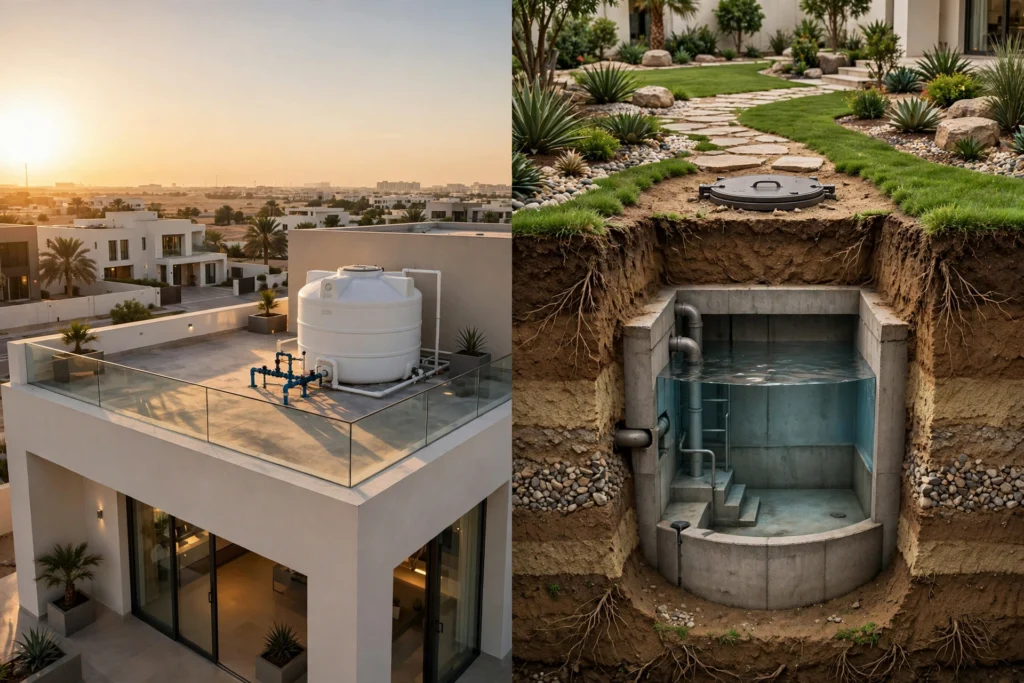
Every villa, building, and farm in the UAE needs reliable water storage — but where the tank actually sits matters just as much as how big it is. The two main choices are overhead tanks, mounted on a roof or raised platform, and underground tanks, buried beneath the ground. Each option has real advantages in the UAE climate, and each comes with trade-offs. This guide compares them side by side so you can choose the placement that fits your property, your space, and your long-term plans.
What Is an Overhead Water Tank?
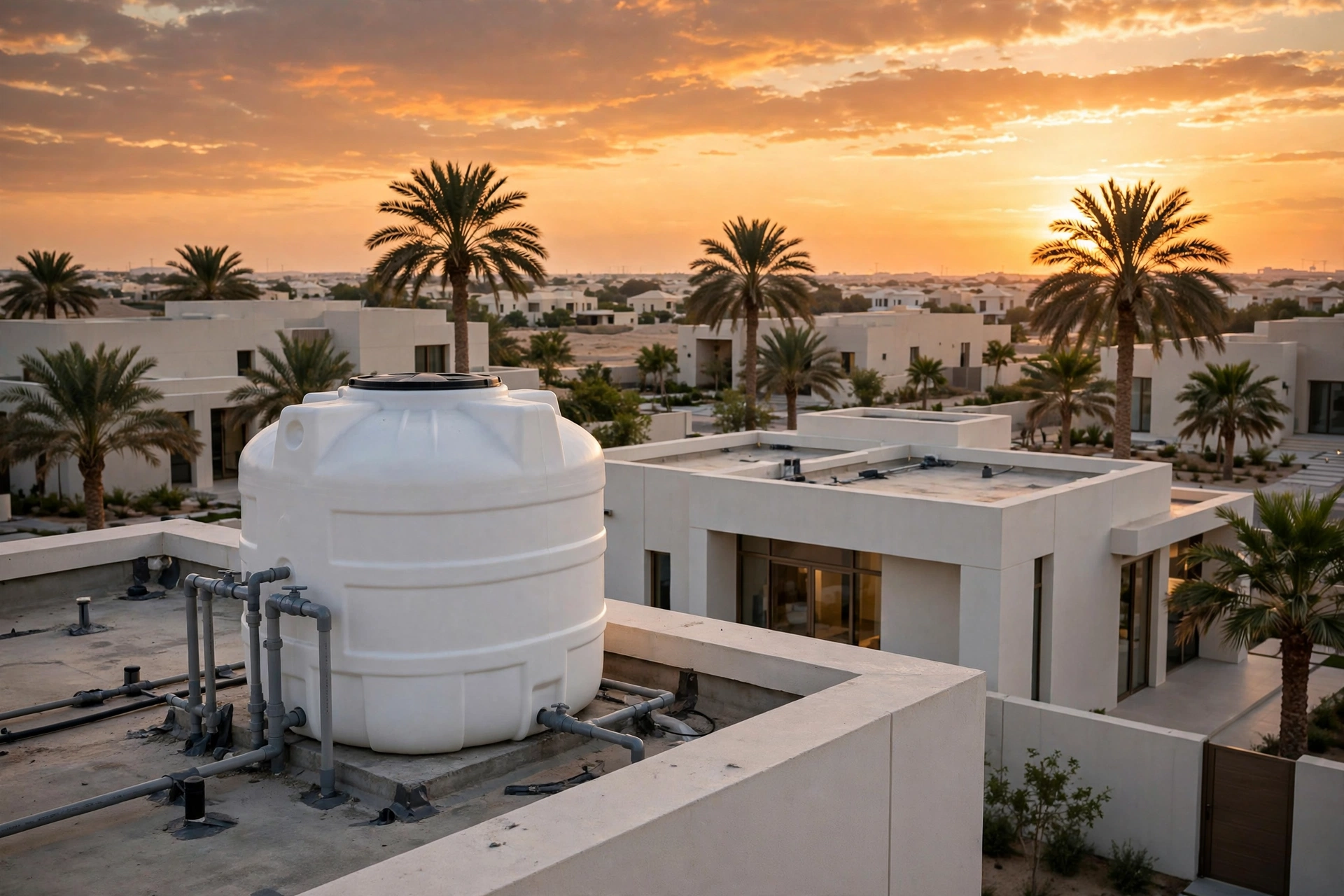
An overhead water tank sits above ground level — usually on a villa roof, a concrete platform, or a steel stand. Gravity does much of the work: water flows down to your taps without a pump, which is one reason overhead tanks are so common across the UAE.
Advantages:
- Gravity-fed supply: water reaches taps naturally, even during a power cut.
- Easy to inspect and clean: the tank is fully accessible, so maintenance is simple.
- Lower installation effort: no excavation is needed — the tank is lifted into place on a prepared base.
Drawbacks:
- Warmer water in summer: a tank sitting in direct sun absorbs heat, so stored water can get noticeably warm in peak summer months.
- Visible on the property: a rooftop tank is part of your skyline, which some villa owners prefer to avoid.
- Weight and structure: the roof or platform must be engineered to carry a full tank safely.
What Is an Underground Water Tank?
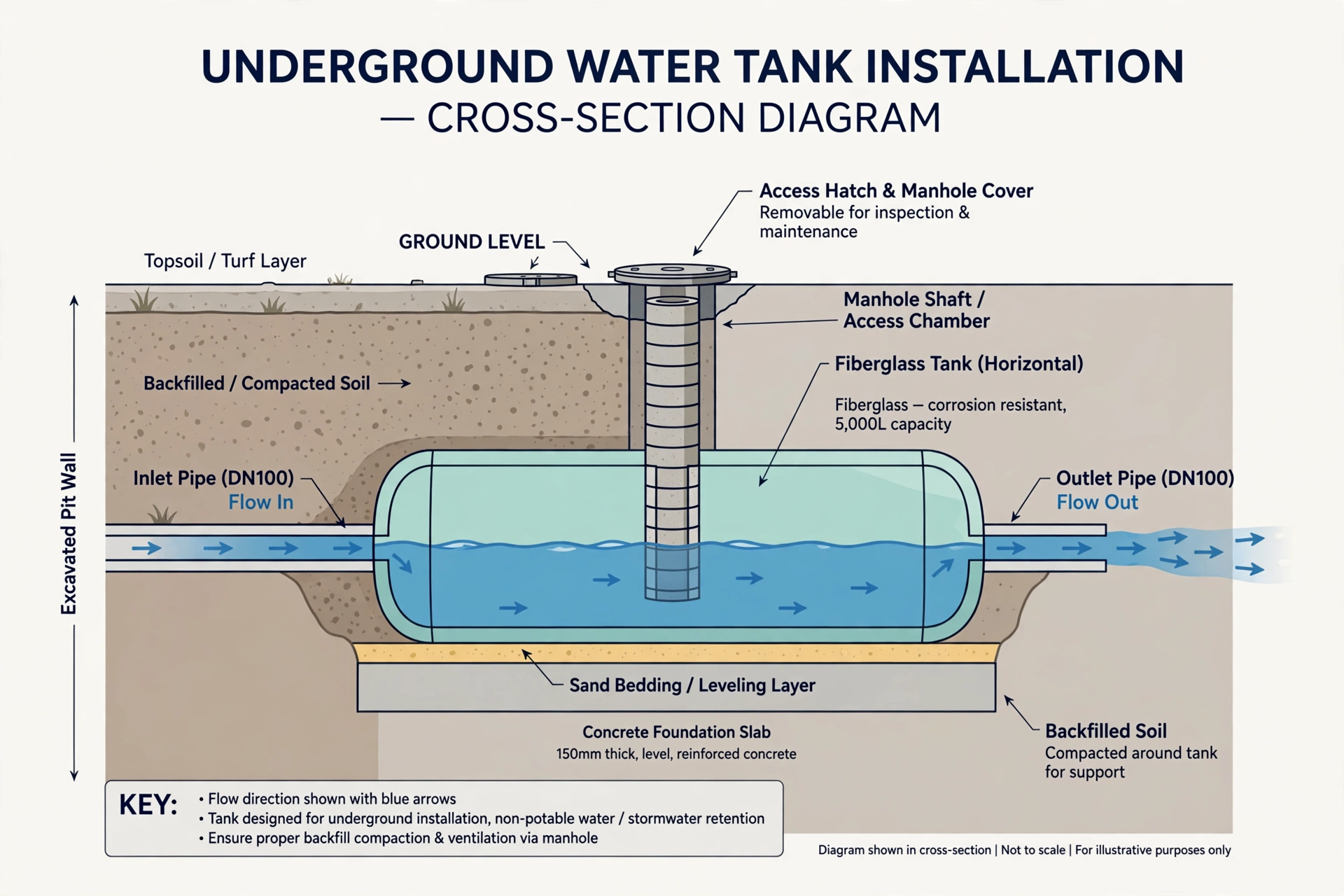
An underground water tank is buried in an excavated pit, usually beside or beneath the property, with only an access hatch visible at ground level. It is a popular choice for villas and buildings where space or appearance matters.
Advantages:
- Cooler water year-round: the surrounding soil insulates the tank, so water stays noticeably cooler through the UAE summer.
- Saves surface space: your garden, parking, and yard stay clear — only a flush access hatch shows.
- Neater appearance: nothing sits on the roofline, keeping the property looking clean.
Drawbacks:
- Needs a pump: water must be pumped up to taps, so supply depends on electricity.
- Harder to access: inspections and cleaning happen through the access hatch, which takes more planning.
- More installation work: excavation, a level concrete foundation, and proper backfilling are all part of the job.
Overhead vs Underground — Side-by-Side Comparison
| Overhead | Underground | |
|---|---|---|
| Installation effort | Low — lifted onto a prepared base | Higher — excavation + concrete foundation |
| Maintenance access | Easy, fully accessible | Through access hatch |
| Water temperature in summer | Warmer (direct sun exposure) | Cooler (soil insulation) |
| Space use | Uses roof or platform space | Frees up surface space |
| Power dependence | Gravity-fed, works during outages | Needs a pump |
| Lifespan | Long, with regular inspection | Long, with proper installation |
Which Tank Material Suits Each Placement?
Placement and material go together. For underground installation, GRP fiberglass water tanks are the natural choice: the material is corrosion-proof, strong under soil load, and well suited to the UAE’s heat and groundwater conditions.
For overhead placement, PVC water tanks are a popular lightweight option — easy to lift onto a roof and widely used on villas across the Emirates.
One rule applies to both: whichever material you choose, the tank must be rated for potable water storage and installed on a level, stable base.
Installation Tips for the UAE
- Start with a level foundation. A tilted tank stresses seams and fittings over time. For underground tanks, pour a flat concrete base before the tank goes in.
- Plan cleaning access from day one. Every tank needs periodic cleaning. Make sure the access hatch is reachable and large enough to work through.
- Keep tanks away from drainage and septic lines. Stored drinking water must never sit near wastewater. Keep a clear separation, and if your property needs one, a properly installed septic tank system should be sited well away from the water tank.
- Shade overhead tanks where possible. A simple shade cover or a sheltered roof position keeps summer water temperatures down.
- Protect underground tanks from surface loads. Do not drive or park over a buried tank unless the installation was specifically designed for it.
Frequently Asked Questions
Does underground water stay cooler?
Yes. The soil around a buried tank acts as natural insulation, so stored water stays cooler through the summer than water in a rooftop tank exposed to direct sun.
Which type lasts longer?
Both can last for many years. Longevity depends more on material quality, correct installation, and regular cleaning than on placement alone.
Can I move an overhead tank later?
Overhead tanks are much easier to relocate than underground ones. An empty overhead tank can be lifted and repositioned, while an underground tank requires fresh excavation.
Do underground tanks need a special material?
Underground tanks need to handle soil pressure and moisture, which is why corrosion-proof GRP fiberglass is the most common choice for buried installations.
How do I clean each type?
Overhead tanks are cleaned by opening the lid and working from above. Underground tanks are cleaned through the access hatch. In both cases, drain the tank, scrub the interior, rinse thoroughly, and refill with clean water.
The Final Word
There is no single ‘best’ placement — only the one that fits your property. Choose overhead if you want simple installation, gravity-fed supply, and easy maintenance. Choose underground if you want cooler water, a clear yard, and a neater look, and you are comfortable with a pump and a bigger installation job. Whichever you pick, the fundamentals stay the same: the right material, a level base, clean access, and regular maintenance. Get those right and your tank will serve your property reliably for years.